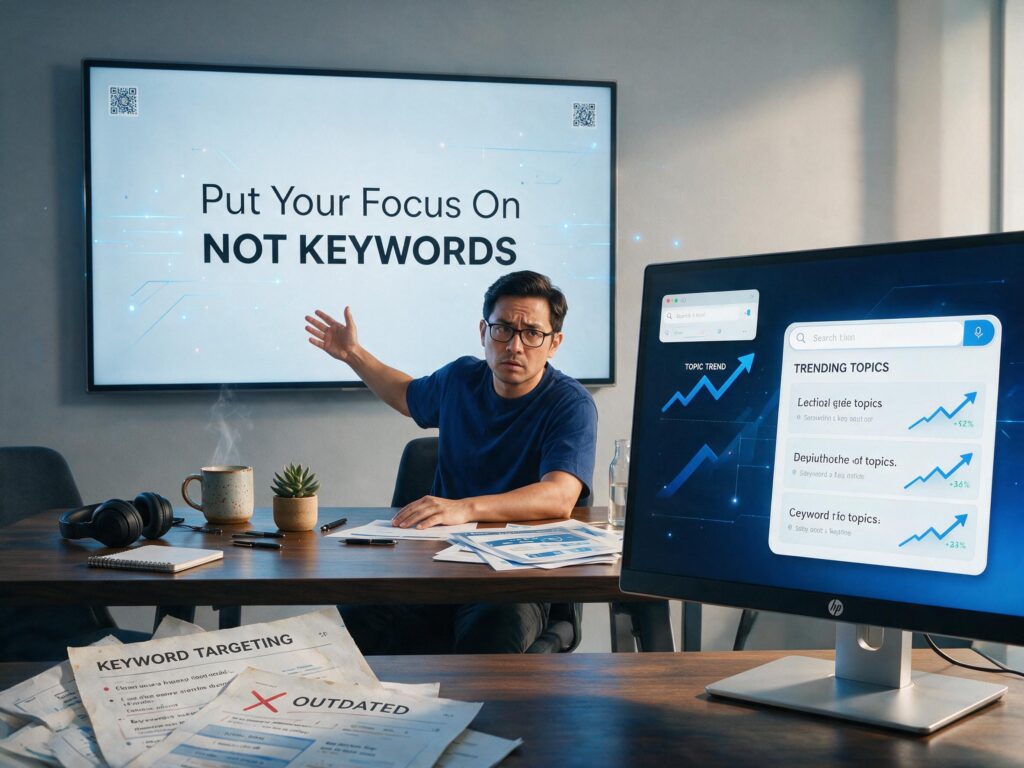
When trying to rank your website in a search engine, focus is everything, but what you focus on has changed more in the last three years than in the previous decade combined. Back when this idea first mattered, the advice was simple: stop obsessing over a single keyword, because without the right focus, you were likely to fail. That advice was true in 2018, and it is even truer now. Except today, “failing” doesn’t just mean a low ranking on page two of Google.
It can mean disappearing entirely from the AI Overviews, ChatGPT Search, Perplexity, and Gemini responses that now sit between your business and a huge share of searchers before they ever reach a traditional results page. AI Overviews now appear on more than 20% of Google searches, and when they do, click through rates drop by nearly 60%. The core lesson of this article, chase topics, not keyword strings hasn’t just aged well. It has become the single most important idea in SEO for 2025-2026.
Current State & Core Concepts
Modern search algorithms focus on topics rather than individual keywords. This is now an established principle, not just a theory. You do not need every possible keyword variation on your web pages. For example, avoid repeating phrases like “cheap travel insurance” excessively. Using “cheapest travel insurance” and similar variations is usually unnecessary. Keyword stuffing can also hurt your search rankings. Google’s systems increasingly identify content that feels manipulative. Its guidelines favor content that provides genuine value to readers. Focus on covering the topic naturally and thoroughly. Write for users first instead of forcing keywords into your content.
It is much more important that the content is related to a particular topic (“cheap travel insurance,” “traveling,” “do I need travel insurance,” etc.). This is precisely what the industry now calls semantic SEO and entity based optimization. Topic clusters should organize content around primary entities, not just keywords. Schema markup can help search engines recognize these entities and their attributes. Google’s Knowledge Graph supports this entity focused approach. It reportedly contains billions of entities and hundreds of billions of connected facts. This structure helps search engines understand relationships between different topics. As a result, one well structured page can rank for many related queries. For example, a strong page about “travel insurance” can rank for hundreds of searches. The goal is to build comprehensive content around the main topic and its related entities.
Long tail key phrases (more than two words in the search string, normally) are becoming more commonplace, that trend has only accelerated. Why? In 2018, one explanation was that Google’s core search results were “somewhat sporadic and meaningless in some competitive sectors.” In 2026, the more accurate explanation is that user behavior has shifted toward full, conversational questions because that is how people now talk to AI powered search interfaces. Getting found online is no longer just about ranking on page one, it’s about being the source AI engines cite when they generate an answer, and that shift rewards natural language, question based content far more than clipped keyword fragments ever did.
Key Developments & Analysis

To alleviate the old problem of irrelevant results, longer phrases were once seen as an easier way to return better results on the engine. Likewise, viewers who used services like Yahoo! Answers were encouraged to use “where can…?” and “what is…?” style phrases, and this pattern has fully translated into Google, Bing, and critically into how people prompt AI chatbots today. If you want proof of the pudding, you no longer need to look only at Google’s search suggestions; you can look directly at the “People Also Ask” boxes, AI Overview follow up questions, and the prompts people type into ChatGPT and Perplexity. Most are full questions, several words long, suggesting this is led entirely by real human search and conversational patterns.
This shift has produced a genuinely new discipline sitting alongside SEO: Generative Engine Optimization (GEO), sometimes called Answer Engine Optimization (AEO). GEO focuses on optimizing digital content so AI powered generative engines like ChatGPT, Perplexity, Claude, Gemini, and Copilot can discover, select, and synthesize it. These platforms combine information from multiple sources to generate responses rather than simply linking to individual pages. Rigorous testing also shows which GEO strategies deserve priority and which ones deliver little value. Controlled research testing nine GEO tactics found that citing statistics with a clear source lifted visibility by nearly 26%, direct quotes from experts by close to 28%, and explicit source citations by roughly 25% while keyword stuffing, padding, and artificial simplification did not help at all. In other words: the original article’s warning against chasing keyword variations wasn’t just correct for 2018, it predicted exactly the behavior AI search systems now actively penalize.
The scale of this shift is worth sitting with. As of March 2026, about 48% of queries trigger AI Overviews. That figure is up 58% compared with the previous year. Organic click through rates also drop when an AI Overview appears. Studies report declines ranging from 34% to 61%. The impact varies across different industries. Healthcare, education, and B2B technology face the highest exposure. AI Overviews appear on roughly 82-88% of queries in these sectors. However, the overall trend remains consistent across industries. Search engines are answering more questions directly on results pages. Comprehensive content now has a stronger chance of earning citations. Well sourced and clearly structured pages are especially valuable. Businesses should therefore focus on building authoritative content around complete topics.
Practical Applications & Best Practices
There will always be a level of experimentation in this, and that hasn’t changed. There are many tools which can assist you in finding the right balance, the tools have just gotten dramatically more capable. Web CEO, Raven, SEMrush, and IBP were the standard names in 2018; today, Semrush is the stronger choice for all in one workflows covering keyword research, content optimization, rank tracking, and site audits, while Ahrefs still edges ahead specifically on backlink analysis, crawling roughly 8 billion pages daily through its Content Explorer tool. Both platforms, along with newer tools like SE Ranking and DataForSEO, now offer AI visibility tracking features. These tools monitor whether ChatGPT, Gemini, and AI Overviews mention or cite your brand. A few years ago, marketers had no way to track this metric.
Of course, Google still has its own tools, but most of these are inextricably linked to Google Ads and aren’t purely focused on organic search positions. That part hasn’t changed, but Google Search Console has become far more valuable as a free starting point. Google Search Console is the best starting point because it’s free and shows real data from Google, and pairing it with a technical crawler and an AI tool for keyword ideas covers most small teams’ needs before they need to pay for anything.
Most of these tools also offer competitor analysis. They can show which topics your competitors are targeting. This remains useful in 2026, but there is an important addition. You should also check whether AI systems cite your competitors. Compare their citations with yours for the same topics. Research from GEO firm Brandlight found a significant change. The overlap between top Google links and AI citations has fallen sharply. It reportedly dropped from 70% to below 20%. Ranking on page one no longer guarantees an AI citation. Likewise, appearing in AI answers does not require page one rankings. You should also measure which key phrases drive valuable traffic. Track which AI citation prompts bring relevant visitors to your business. Then, decide where to build deeper topical authority. Use structured, interlinked topic clusters instead of isolated blog posts.
Practically, this means organizing your website around a pillar page. The pillar page should cover a broad subject in detail. Link it to multiple subpages that explore related topics. This structure creates a topic cluster around the main subject. It helps search engines understand your website’s topical authority. It also strengthens your internal linking structure. Topic clusters can reduce keyword cannibalization between related pages. They can also signal expertise across an entire subject. This approach can improve rankings for multiple related searches. You are no longer targeting just one keyword or search term.
Risks, Challenges & Future Outlook

Search patterns are forever changing, but what is not changing is the need for relevancy in the results. Searching for a specific product or service can become extremely frustrating when irrelevant results flood the search results. Today, that frustration also extends to AI generated answers that hallucinate information or cite outdated sources. The stakes for getting this wrong are also measurably higher than in 2018. Bain & Company found that 80% of consumers now use AI generated results.
These results influence at least 40% of their searches. Organic web traffic has also declined across many industries. The estimated decline ranges from 15% to 25%. Zero click searches now account for roughly 68% of Google searches. These searches end without users visiting another website. That figure was around 45% a decade ago. The fastest growth has occurred during the past two years. However, the impact varies significantly by industry. This difference can help businesses prioritize their efforts. E-commerce and shopping searches now trigger fewer AI Overviews.
They appear on about 3.2% of these searches. That figure has fallen from an initial 29%. Google found that AI responses were not generating enough sales. As a result, commercial searches still generate meaningful website traffic. Examples include “buy X,” “best X for Y,” and “price of X.” These searches receive more clicks than generic informational searches. AI Overviews now capture many “how to” searches. In some cases, their coverage approaches 100%. The practical takeaway is clear for businesses. Generic informational guides face the highest risk of losing clicks. Comparison content and case studies remain more resilient. Product pages with specific numbers also tend to perform better.
Focus online is everything that line from the original article has, if anything, become an understatement. Understand your audience and analyze your competitors. Experiment with long tail keywords and full question search formats. Review the results using your analytics tools. Also monitor your AI citations to measure visibility. If you lack the time, consider hiring an SEO and GEO company. These services can handle the research and optimization work for you. Modern SEO work now includes structured data implementation. It also includes entity optimization and regular content reviews. Quarterly content freshness reviews are increasingly important. Fresh content can be about three times more valuable for maintaining AI citations. This makes quarterly updates close to a minimum requirement. They are no longer simply a useful optional strategy.
FAQ
1. Do keywords still matter at all in 2026 SEO? Yes, but as inputs rather than the strategy itself. Keywords tell you what people are searching for and remain valuable for surfacing the questions worth building content clusters around, but topic clusters, not individual keyword targeting, now drive the authority that earns rankings and AI citations.
2. What is a topic cluster and why does it beat single keyword pages? A topic cluster is a content structure where a central pillar page covers a broad topic and links to multiple related subpages that explore subtopics in depth, helping search engines understand topical authority and reducing keyword cannibalization.
3. What is Generative Engine Optimization (GEO) and how is it different from SEO? GEO optimizes content specifically to be retrieved and cited by AI systems like ChatGPT, Perplexity, and Google AI Overviews, rather than just to rank in traditional blue link results. SEO focuses on keywords, technical optimization, and backlinks, while GEO adds a layer focused on how AI engines summarize, compare, and cite sources before a user ever clicks.
4. How much has AI Overviews actually reduced organic traffic? Organic click through rate drops between 34% and 61% when an AI Overview appears on a search result page, and roughly 48% of queries were triggering an AI Overview as of March 2026.
5. Which types of content are most and least affected by AI Overviews? Generic “how to” informational queries are cannibalized by AI Overviews at close to 100%, while e-commerce and transactional “buy X” or “best X for Y” queries currently see AI Overviews on only around 3.2% of searches.
6. What tools should I use for topic and keyword research in 2026? Google Search Console remains the best free starting point since it shows real ranking data from your own site. Semrush is the stronger all in one platform for keyword research, content optimization, and site audits, while Ahrefs edges ahead specifically for backlink and competitive content analysis.
7. How often should I update content to stay visible in AI search? Content freshness matters roughly three times more for maintaining AI citations, so updating core content at least quarterly is now close to a baseline requirement.
8. Does ranking #1 on Google still guarantee visibility in AI answers? No. Research indicates the overlap between top Google links and AI cited sources has dropped from around 70% to below 20%, meaning a page can rank well without being cited by AI, and vice versa.
Conclusion
Whichever approach you choose, one truth from the original article remains stronger than ever. Key phrases bring vanity. Topic led searches that bring visitors bring sanity. In 2018, this meant avoiding ten variations of the same keyword. Today, the idea has become much broader. Build genuine topical authority through interconnected content clusters. Support every important claim with real data and clear sources.
Structure content so readers can find answers quickly. Make your content easy for AI systems to understand and extract. Treat visibility in AI Overviews, ChatGPT Search, and Perplexity as seriously as traditional search rankings. Ranking is no longer only about backlinks or keyword density. It is about becoming a trusted authority within your topic. Choose your SEO approach carefully. You can chase scattered keywords and lose ground over time. Or, you can build deep, topic focused SEO that earns citations. This approach also aligns with what Google and AI search engines increasingly reward. Happy searching.
Article updated time 31.08.2026