
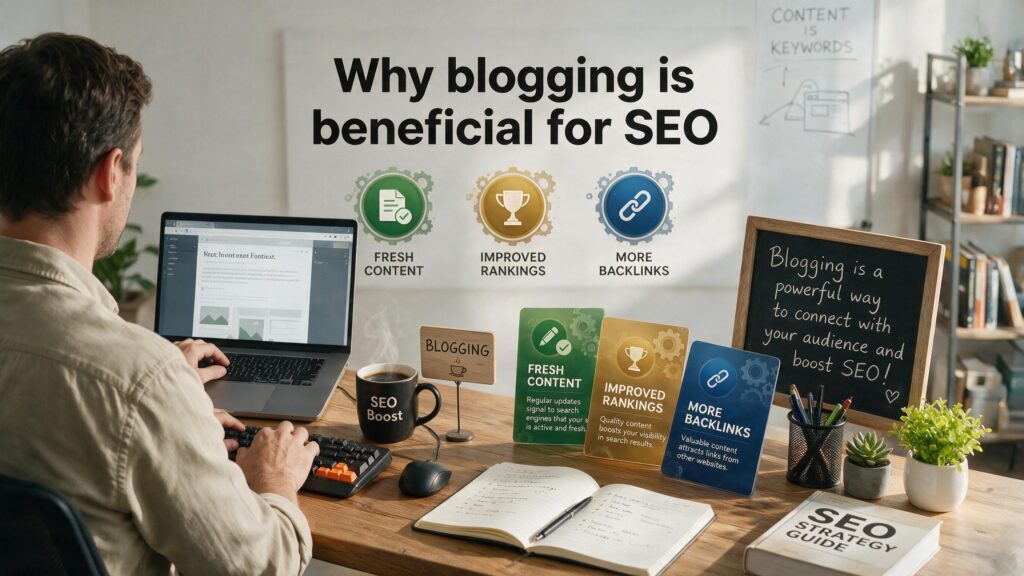
As a business owner, you probably realize the importance of driving web traffic to your website. That principle has remained the same, but the stakes have grown higher. Having a website isn’t enough. If Google doesn’t rank it on the first page or AI answers don’t mention it, your audience may never see it. In 2026, AI-generated answers have become a major part of search. Google’s AI Overviews appear on about half of all searches. Ahrefs data also shows that top 10 organic results make up only 38% of AI Overview citations, down from 76% a year earlier.In plain terms: ranking well is no longer enough on its own. You need content substantial enough to be cited, not just indexed.
This is where blogging comes in. A blog can establish your industry expertise and improve SEO rankings. It can also increase your visibility in AI Overviews, ChatGPT, Perplexity, and Gemini. This shift matters. HubSpot’s 2026 State of Marketing Report ranks websites, blogs, and SEO as the highest ROI marketing channel. Small businesses are also 23% more likely to see strong returns from blogging. Blogging isn’t a nice to have side project anymore, it’s the backbone of how a modern business gets found.
SEO is a quick tutorial
Search engine optimization, or SEO, involves a series of actions you can take to improve your website’s organic search ranking. The goal is to get your web page onto the first page of Google search results instead of leaving it buried on page six. In 2026, that question has expanded. It’s no longer just “does it appear on page one,” but “does it appear in the answer itself.” Search now has two main paths: traditional rankings and AI-generated summaries with citations. Both require helpful, accurate, and well-structured content. AI search adds a new requirement. Content should include clear, self-contained answers of around 100-300 words that AI models can easily understand and use.
Sometimes SEO involves the use of keywords; other times, it involves making sure your content pages hit certain word counts. That principle still holds, but the numbers have shifted. Orbit Media’s 2025 survey found that the average blog post is about 1,333 words, while posts over 2,000 words are nearly twice as likely to deliver strong results. Backlinko’s analysis of 900+ million posts also found that content over 3,000 words earns 77% more referring domains. Length alone isn’t the goal, depth, thoroughness, and original information matter. Google’s March 2026 core update reinforced this by emphasizing “information gain”: content that adds something genuinely new rather than repackaging existing results.
Cross-linking to social media sites, such as Facebook, Twitter, and Google+, can also be helpful. Two of those three platforms have changed dramatically, while the third no longer exists. Google+ shut down years ago, and Twitter rebranded as X. The underlying advice still applies, just to a wider and more fragmented set of channels: LinkedIn, Instagram, X, TikTok, YouTube, and Facebook all remain relevant distribution points for blog content in 2026, with short-form video now cited by roughly 49% of marketers as their top-performing content format. Most people understand the importance of the things we’ve listed above, but far fewer people understand how blogging for SEO combined with disciplined content marketing tips and a mix of digital marketing channels can meaningfully increase web traffic and qualified leads.
Fresh content is important
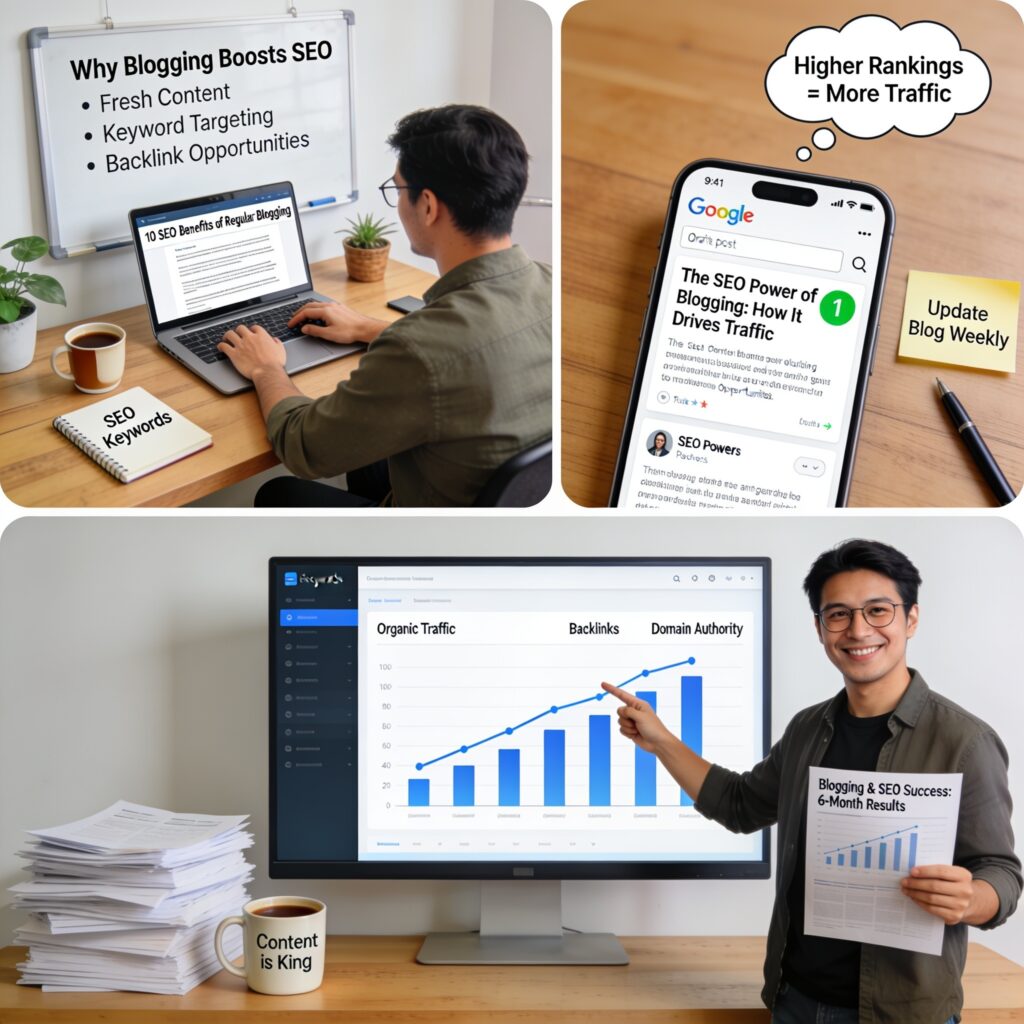
If you haven’t updated your website in a long time, its ranking will suffer. Why? Because search engine crawlers love, we stress, love websites that you update regularly or semi-regularly. That principle hasn’t just survived into 2026, it’s intensified. Alongside Googlebot and Bingbot, a new generation of AI crawlers including OpenAI’s GPTBot, Anthropic’s ClaudeBot, and PerplexityBot, now regularly index fresh web content to power real-time answers in AI search tools. A stale website isn’t just invisible to Google, it’s invisible to an entire new layer of AI-powered discovery.
When you ignore web content, search engines may see your website as outdated. This can hurt your rankings. DemandSage research shows that active blogs have 434% more indexed pages. Companies that publish 16 or more posts per month also get about 3.5 times more traffic than those publishing 4 posts. Each blog post adds a new page to your website. This gives search engines and AI systems more content to crawl, evaluate, and cite.
Crawlers are like people. They need to be fed regularly. The one nuance worth adding for 2026: quality now matters as much as frequency. Google’s guidance and independent research both point to the same conclusion, publishing thin, repetitive posts just to hit a schedule can actually work against you, while a smaller volume of deeply researched, regularly refreshed articles (updated with new statistics, examples, and a visible “last updated” date) performs better for both classic rankings and AI citation eligibility.
It gives you fresh content for social media
If you’re not using your social media accounts to link to your website, you should be. That advice is timeless, even as the platforms themselves have turned over. When you blog, you provide valuable information that people can share on platforms such as LinkedIn, X, Facebook, Instagram, TikTok, and YouTube. Google+ is gone, while Instagram, TikTok, and YouTube have become essential parts of the social media mix that didn’t exist a decade ago. Not only does this help provide exposure for your business, it also gives users opportunities to share your content, and it gives you a steady stream of source material for Facebook posts for business, LinkedIn updates, and short-form video clips pulled directly from blog topics.
Remember, when you blog, it’s not just about putting words on a page. You’ll want to blog with a purpose, and in 2026 that purpose increasingly includes visual and video repurposing. Blog posts with visuals get 650% higher engagement than text-only posts. Short-form video from existing blog content also offers strong ROI. One well-researched blog post can create a week of social media content. This can include a LinkedIn carousel, a 60-second video, quote graphics, and an email newsletter. All can link back to one authoritative page, increasing the value of your content.
Blogging helps establish you as an authority
Some of the best blog topics consist of FAQs within your industry. For example, an HVAC company can share spring maintenance tips or explain how to extend the life of heating and cooling equipment. Question-based content works especially well for featured snippets and AI Overviews. Use clear headings that ask questions. Follow each heading with a direct, self-contained answer of about 40-70 words. This approach helps users, search engines, and AI systems find useful information quickly.
Not only does this provide valuable information for your customers, it helps establish that you’re an expert in your line of work. In 2026, that expertise has a name, Google’s framework for Experience, Expertise, Authoritativeness, and Trustworthiness. It’s no longer an abstract quality signal. Google’s Search Central documentation now explicitly recommends named author bios with verifiable credentials. Research into AI Overview citations also shows that AI systems favor content from real, credentialed authors with consistent publishing histories over anonymous or generic content. Original data, first-hand case studies, and specific real-world examples demonstrate the kind of on-the-ground expertise that generic AI-written summaries often lack. That expertise helps content earn citations instead of getting ignored.
At Denver Digital, we have years of experience helping businesses throughout the U.S. expand their digital footprint, and we’ve watched this authority building process evolve firsthand: from simple keyword stuffing in the early 2010s, to content quality focused updates in the 2020s, to today’s landscape where a blog post needs to satisfy a human reader, a Google ranking algorithm, and a large language model’s citation criteria all at once. Businesses that treat their blog as a genuine knowledge base, not just an SEO checkbox, consistently outperform. Content marketers who actively use blogs to generate leads now make up 76% of the profession, and companies that maintain a blog report 55% more website visitors than those that don’t, underscoring just how directly authority-building content translates into measurable business growth.
Frequently Asked Questions
Does blogging still help SEO in 2026, with AI Overviews everywhere? Yes. HubSpot’s 2026 data ranks website, blog, and SEO as the top ROI-generating marketing channel, and Google’s own guidance confirms AI Overviews draw from the same index and quality signals as traditional organic search, so a strong blog still underpins both.
How long should a blog post be for SEO in 2026? There’s no fixed number, but data trends favor thoroughness: the 2025 average blog post runs about 1,333 words, and posts over 2,000 words are nearly twice as likely to report strong results. Prioritize covering the topic completely over hitting an arbitrary count.
How often should a business publish new blog content? Companies publishing 16 or more posts a month see roughly 3.5 times more traffic than those publishing zero to four, but consistency and quality matter more than raw frequency, a smaller volume of well researched, regularly refreshed posts often outperforms high volume, low depth publishing.
What is E-E-A-T, and why does it matter for blogging? E-E-A-T stands for Experience, Expertise, Authoritativeness, and Trustworthiness, Google’s framework for judging content quality. It’s now central to both organic rankings and whether AI Overviews, ChatGPT, and Perplexity choose to cite your content.
Do I still need to worry about social media if I have a blog? Yes. Blog content remains the raw material for social distribution, LinkedIn posts, short-form video, and Facebook posts for business all perform better when built from a well-researched blog post rather than created from scratch.
Is keyword stuffing still an effective SEO tactic? No. Search in 2026 is intent-driven. Google and AI search engines evaluate whether content genuinely answers the searcher’s underlying question, not whether it repeats a target phrase a set number of times.
Can a small business really compete for SEO visibility against larger competitors? Yes, HubSpot’s 2026 data shows small businesses are actually 23% more likely than average to see strong ROI from blogging, largely because focused, niche expertise and genuine first-hand experience are exactly what E-E-A-T and AI citation systems reward.
Conclusion
Blogging remains essential for a serious digital marketing strategy. In 2026, its value has only grown. Blogs provide fresh content for search engines and support long-term website growth. They can improve organic rankings and provide material for social media. They also increase visibility in AI Overviews, ChatGPT answers, and Perplexity summaries. Companies with blogs see 55% more website visitors and 434% more indexed pages. Marketers also consistently rank websites, blogs, and SEO among the highest-ROI channels.
None of that happens by accident. Success requires fresh content, a consistent publishing schedule, and real experience. It also means answering the questions your customers ask today, not outdated ranking-focused questions. Businesses must also build brand awareness across channels like LinkedIn, short-form video, and optimized landing pages. This combination of authority, freshness, and distribution helps websites rank higher and appear in AI-generated answers.
At Denver Digital, we’ve spent years helping businesses across the U.S. build exactly that kind of digital footprint, and we’ve adapted that expertise alongside every major shift in how search works from keyword-driven rankings to today’s AI-powered answer engines. If your blog hasn’t been updated recently, or if you’re not sure whether your content is built to earn citations in 2026’s search landscape, that’s a conversation worth having. Reach out to Denver Digital to talk through a content strategy built for how people and AI actually search today.