

Meta descriptions are at the foundation of all SEO content, and that hasn’t changed since Denver Digital first covered this topic, what has changed is nearly everything about how they’re written, measured, and even whether Google decides to use them at all. A meta description is still the short HTML snippet that provides a summary of each page on your site, appearing beneath your title tag and URL in the search results. But in 2025-2026, that snippet now competes for attention against Google’s AI Overviews, ChatGPT Search, Perplexity, and Gemini’s AI generated summaries, meaning the description that convinces a human to click has to work harder than ever.
This is useful for Google, and potential customers, because it provides a clear idea of your page’s purpose. As of now, meta descriptions do not directly affect your SEO ranking. Google has confirmed this for years. Nothing in the 2025-2026 algorithm updates has changed that.
What has changed is the importance of click through rate (CTR). AI Overviews now appear for many Google searches. Their presence continues to grow. AI search tools like ChatGPT Search and Perplexity are also gaining search traffic. These changes make every organic click more valuable. A strong meta description can help attract those clicks. For this reason, meta descriptions remain an important part of successful SEO content. In this refreshed guide, Denver Digital explains how to write a powerful meta description for how people and AI systems actually search today.
The Current State of Meta Descriptions in 2025-2026
Before diving into technique, it’s worth being honest about a wrinkle the original version of this post couldn’t have addressed: multiple independent studies, including research from Ahrefs and Portent, have found that Google rewrites the meta description you write somewhere between roughly 62% and 71% of the time, substituting a snippet pulled from your page’s body content instead. Google does this when it believes a passage on the page answers the searcher’s specific query more precisely than your static description does. That means the description you write is shown verbatim only a minority of the time commonly cited around 30-37% which is exactly why the fundamentals below matter more now, not less. A vague or generic description is far more likely to get swapped out; a precise, content matched one is more likely to survive.
The other major shift is the rise of AI-powered search. Google’s AI Overviews now appear across many search queries. Their presence continues to grow. ChatGPT Search and Perplexity have also become popular discovery tools. These systems use page content differently from traditional search snippets. They extract and combine information directly from your pages. They favor content with clear purpose and useful structure. This makes clear writing more important than ever. Your meta description and page content should follow the same principle. Explain clearly what your page covers and who it serves.
Active Voice
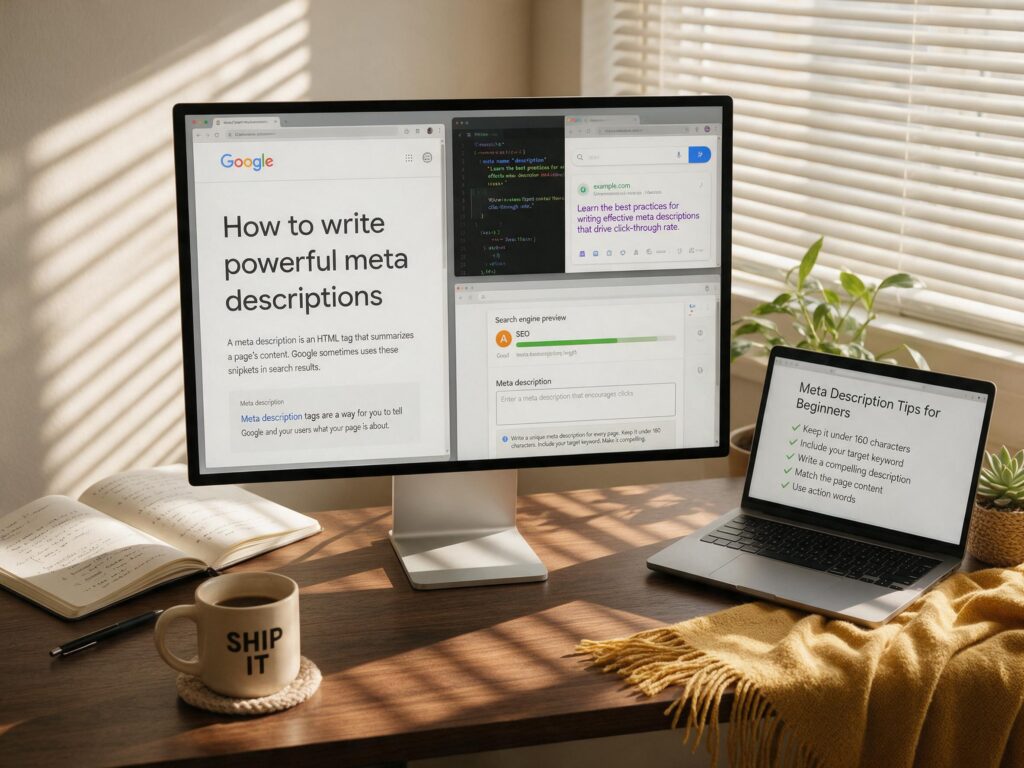
Google, along with content platforms like WordPress, Yoast, and modern AI writing assistants, still prefers content with an active voice and this holds true in 2025-2026 for both classic search snippets and AI generated answers. Active voice is direct and engages the client. In this form of writing, the person is typically the subject; they are performing the action. You may think this is arbitrary. However, active voice creates a clearer and more direct message. It also improves the quality of your writing. This matters even more with AI powered search. Large language models process clear, declarative statements more easily. They use these statements when creating answers for users.
A passive, hedging meta description is both weaker for human readers and harder for an AI system to lift cleanly as a citation. Compare “We design custom websites for Denver small businesses” to “Custom websites for Denver small businesses are designed by our team”. The active version reads faster, sounds more confident, and gives both search engines and AI systems an unambiguous subject verb object statement to work with.
135-160 Characters
Meta descriptions can technically still contain up to around 160 characters, but the underlying rule has always been about pixel width, not character count something the original guidance simplified. Google displays search snippets inside a fixed width box. The box is roughly 920 pixels wide on desktop. On mobile, it is closer to 680 pixels. Google truncates text when it reaches this limit. It then adds an ellipsis. This means character count is not a reliable measurement. Letters also vary in width. For example, “W” and “M” are much wider than “i” and “l”. Therefore, two descriptions with the same character count can display differently.
For 2025-2026, aim for 140-155 characters on desktop. Use around 120 characters to protect your message on mobile. Mobile now generates over half of organic search traffic for many sites. Therefore, writing for mobile first is the safer strategy. Shorter descriptions make your page summary easier to understand. They also help customers see your complete message without truncation. A cut off call to action can cost you a click. Free SERP preview and pixel-width checker tools can validate your draft before it goes live.
Clear Purpose
Know what your page is about, and state it in the first 100-120 characters of your meta description, front loading your primary point is now standard practice, since that’s the portion most likely to survive truncation and the portion an AI system is most likely to extract for a citation. Your page’s purpose should be stated clearly and specifically in the meta description. A clear, specific purpose keeps your content unique and prevents it from becoming buried in a search engine or ignored by an AI Overview, which tends to favor pages that answer a question precisely over pages with vague, generic copy.
This is also where E-E-A-T enters the picture. It stands for Experience, Expertise, Authoritativeness, and Trustworthiness. Google’s quality guidelines value content that demonstrates real, first-hand expertise. A clear meta description can support this signal. It should explain the specific problem your page solves. Avoid simply listing generic keywords. Precise articles can attract a niche, high intent audience. They can also improve visibility across traditional search and AI generated answers.
Match Content
Lastly, ensure your meta description matches your page content. This rule matters more than ever in 2025-2026. Google and AI answer engines can detect content mismatches more effectively. Your description should accurately reflect what the page delivers. A mismatched meta description fails its basic purpose. Google’s rewrite system can detect these inconsistencies. It may replace your description with a more relevant passage from the page.
Mismatched meta descriptions still result in a lower effective page ranking through reduced click through rate and increased bounce rate, and both outcomes are entirely avoidable with a few extra minutes of editing. A useful modern check: read your target keyword’s actual search intent and confirm your meta description promises exactly that outcome nothing more, nothing less.
Risks, Challenges & What’s Next

The biggest challenge in 2025-2026 isn’t writing a good meta description, it’s accepting that Google may not use it. With rewrite rates commonly cited between roughly 62% and 71%, and some individual studies reporting figures as high as 80%+ for specific query types, some marketers have argued meta descriptions are no longer worth the time investment. Denver Digital’s position is more measured: because Google is most likely to keep your written description when it’s specific, well matched, and precisely targeted to a single primary query, the effort isn’t wasted, it’s simply higher leverage on your highest value pages than across an entire long tail blog archive. For lower priority pages, letting Google auto generate a snippet from strong body copy is a defensible strategy, provided that body copy is itself clear and well structured.
Looking ahead, the bigger shift to plan for is generative engine optimization (GEO): as AI Overviews, ChatGPT Search, and Perplexity capture a growing share of query volume, the skills that make a strong meta description,clarity, specificity, active voice, and an honest match to page content are the same skills that earn citations inside AI generated answers. Treat your meta description less as an isolated SEO checkbox and more as a proof of concept for how clearly your whole page communicates its purpose.
FAQ
Is a meta description still a Google ranking factor in 2026? No. Google has repeatedly confirmed that meta descriptions do not directly influence rankings. Their value is indirect, a compelling, accurate description improves click through rate, and CTR patterns can influence visibility over time.
How long should a meta description be in 2026? Aim for roughly 140-155 characters for desktop and closer to 120 characters for mobile. The real constraint is pixel width (about 920px desktop, 680px mobile), so character count is a useful proxy rather than a hard rule.
Why does Google rewrite my meta description? Google rewrites descriptions when it believes a different passage on your page better matches the searcher’s specific query, when your description is vague or generic, or when you don’t have one set at all. Independent studies put the rewrite rate between roughly 62% and 71%.
Do meta descriptions matter for AI Overviews, ChatGPT Search, or Perplexity? Not directly, these systems generate summaries from your page’s full content rather than reading your meta tag. However, the same clarity and active voice writing that make a strong meta description also help AI systems extract and cite your content accurately.
Should every page have a custom meta description? Yes, especially your highest-value pages. For long tail blog content, a well written description is still worthwhile, but Google’s own rewritten snippet may sometimes serve the searcher better.
What’s the biggest mistake to avoid? Writing a meta description that doesn’t match the actual page content. Mismatches hurt click through rate, increase bounce rate, and are the single most common trigger for Google to discard your description and write its own.
Conclusion
Meta descriptions remain a foundational, if quietly evolving, piece of SEO content in 2025-2026. The core advice still holds: use active voice and keep your description within Google’s display limits. Clearly state your page’s purpose. Make sure the description accurately reflects the page content. What’s changed is the context. Pixel width now matters more than simple character counts. Google also rewrites many meta descriptions. AI powered search systems add another audience. Tools like AI Overviews, ChatGPT Search, and Perplexity synthesize answers from web content. They reward the same clarity and precision that make a strong meta description effective.
Get these fundamentals right, prioritize your highest value pages, and you’ll improve your click through rate across both traditional search results and the AI generated answers increasingly shaping how customers find you. If you’d like Denver Digital to audit your site’s meta descriptions and align them with 2026 best practices, reach out to our team today.
This page was updated date -15.09.2026