The days of pulling out the Yellow Pages to find business listings are long gone and today, even the “just Google it” era faces a bigger shift. If your business doesn’t have a website or your website isn’t optimized, you’re missing valuable opportunities! Don’t let a lack of an online presence cause you to miss out on opportunities. It’s no longer just search engines you need to worry about, either. In 2026, your customers are just as likely to ask ChatGPT, Perplexity, or Google’s AI Overviews to recommend a business as they are to type a query into a traditional search bar and if you’re not visible in those answers, you don’t exist to that customer at all.
If you build it, they will come
Your customers need to be able to find you. Today, most people start their search for a business or service provider online. That was true in 2018, and it’s even truer now: research shows that roughly 81% of consumers research a business online before making a purchase or using its services, and 84% of consumers search for local businesses online on a daily basis.
You read that correctly. Nearly everyone turns to the internet, but “the internet” now means something broader than it did a few years ago. This includes Google’s local map pack and Apple Maps. It also includes Instagram and TikTok search. Increasingly, it includes AI assistants. These assistants can summarize your business before customers visit your website. Roughly 60% of consumers now click AI generated overviews in Google Search. They do so before deciding where to go. Searches triggering an AI Overview show an average zero click rate of around 83%.
Customers often get their answers without clicking a traditional blue link. That answer may even include which business to call. Your customers are online. If they cannot find you, they may choose a competitor. This can happen on Google, maps, or AI-generated answers. Worse, the businesses that haven’t caught up are still a meaningful group: an estimated 27% of small businesses in the United States still don’t have a website as of 2026, down from 36% in 2020. That’s real progress, but it also means roughly 1 in 4 local competitors is still invisible online, which is either your biggest threat or your biggest opportunity, depending on which side of that number your business falls on.
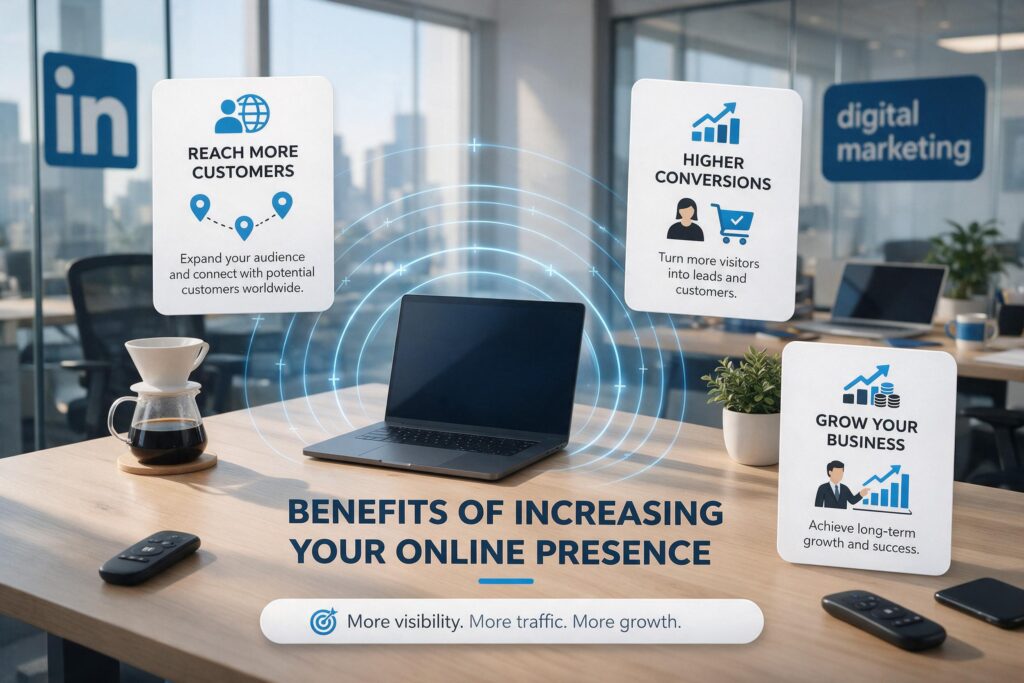
Increasing your online presence allows you to build a stronger brand
A website can help you differentiate your business from the guy down the street. If you have a great website, it can help you improve your sales performance and increase your credibility. That hasn’t changed, but the bar for what counts as a “great” website has risen sharply. Site speed and mobile usability now influence how search engines assess your site. Clear, structured information also matters. Genuine expertise is another important factor.
Google uses these signals when evaluating websites. AI search tools increasingly use them too. These signals can determine whether your site gets recommended. Research shows that website design shapes 94% of first impressions. Small-business owners also recognize the impact. About 62% of surveyed owners consider their website crucial for attracting customers. Another 48% say their website has improved their credibility.
A well designed, well marketed website is a great way to share the achievements of your brand and reviews have become an even bigger part of that story than they were in 2018. If you provide a service, you can talk about how well you’re rated on Google, Yelp, or Angi (formerly Angie’s List). If you sell apparel or accessories, you can highlight the people or industries you’ve been selling to. This matters more than ever: 99% of American consumers now read online reviews before purchasing, and 92% specifically read reviews of local businesses before their first visit. Google alone now hosts the majority of those reviews and remains the platform customers trust most, so keeping your Google Business Profile active, current, and full of recent reviews is now just as important as the words on your homepage.
E-commerce is here to stay
In Northeastern Pennsylvania, in a small town just outside Philadelphia, lies an independently owned and operated coffee shop. Once upon a time, someone talked the owner of that coffee shop into expanding his online presence. Today, they sell their coffee to customers all throughout the US and the US Virgin Islands.
That single shop story has since become the norm rather than the exception. Global retail e commerce sales could reach roughly $6.88 trillion in 2026, accounting for about 21% of all retail commerce worldwide, while more than 2.77 billion people around the world now shop online. What used to be a bold move for one coffee shop owner is now baseline behavior for consumers everywhere.
In the current day and age, your business doesn’t have to be bound by geography. The world is, and can be, your oyster. If you have a strong online presence, your customers can live anywhere in the world and thanks to affordable e commerce platforms, AI assisted product recommendations, and streamlined shipping and fulfillment tools, even the smallest local business can now compete for customers well outside its zip code, without the overhead that used to make national or global reach unrealistic.
Online advertising is far less expensive than print advertising
When you advertise in a newspaper or magazine, you’re not only paying for the space, you’re also taking a gamble on whether readers will happen to turn to the page your ad is on. Print ads are expensive and inefficient, and that gap has only widened. Global print advertising spending is now declining. Forecasts expect print spending to fall roughly 3% in 2026 alone. Digital advertising continues to grow. Global advertising spending surpassed $1 trillion in 2025. Digital channels now account for about 73% of total spending. Traditional media holds a shrinking share. This includes print, television, radio, and out of home advertising. The world is evolving, your advertising strategy needs to evolve along with it.
When you advertise on the internet, the space is endless. Internet advertising also lets you track how many times people view your ad, how long they view it, which device they use, whether they click, and whether that click leads to a phone call, form submission, or sale. That level of accountability simply doesn’t exist in print.Today’s tools go even further. Platforms can show conversion rates by keyword. They can also retarget visitors who leave without buying.
Local businesses have even more options. Ad platforms can connect spending directly to phone calls. They can also track driving directions and store visits. These results are often available within 24 hours of the search itself. You’ll never get that type of feedback from a print campaign.
The new frontier: AI search and answer engines

The original article focused on search engines and online ads. By 2026, online presence includes another important layer. That layer is generative AI search. Consumers now ask tools like ChatGPT, Perplexity, Google AI Mode, and Gemini for recommendations. They use these tools like they once used friends or directories. This shift has created new disciplines alongside traditional SEO. These include Answer Engine Optimization (AEO) and Generative Engine Optimization (GEO). AEO and GEO focus on structuring website content for AI tools. The goal is to help these tools understand and trust your content. It also helps them cite your business by name in their answers.
This shift changes the stakes for having a website. Being cited in an AI generated answer carries real weight with consumers because the recommendation feels vetted rather than paid for. Businesses that appear in these AI answers also see better results when customers click through. A business’s online presence no longer depends solely on its ranking position; it also depends on whether it appears at all in the growing share of searches that produce no traditional list of links.
Don’t get left behind, get started today
My Denver Digital began in 2015, and since then, we’ve worked to bring affordable digital marketing services to small businesses throughout the United States. The meaning of “digital marketing” has expanded considerably since then,it now includes a fast, mobile optimized website, a fully built out Google Business Profile, a review generation strategy, and content that reaches both traditional search engines and AI answer engines. The businesses winning locally in 2026 are the ones treating all of these as one connected strategy rather than separate projects.
Regardless of whether you need help sprucing up your website, enhancing your search engine optimization (SEO) and answer engine visibility, or building out a custom, comprehensive internet marketing strategy that spans your website, local listings, reviews, and advertising, we can help.
Contact our office today to learn how we can help you reach your business goals, before another 1 in 4 competitors who are still invisible online decides to catch up first.
Frequently Asked Questions
Why is having an online presence important for a small business in 2026? Because the vast majority of buying decisions now start online. Research shows that roughly 81% of consumers research a business online before making a purchase, and a growing share of those searches now receive direct answers from Google’s AI Overviews or AI assistants like ChatGPT. Without a strong, optimized online presence, a business can miss those conversations entirely.
What percentage of small businesses still don’t have a website? Estimates for 2026 put the figure at roughly 27% of U.S. small businesses without a website, down from about 36% in 2020. The number keeps shrinking, but it also means a meaningful share of competitors in almost any local market are still easy to out position online.
Is online advertising really cheaper than print advertising? Generally, yes, and the trend has accelerated. Global ad spend has shifted heavily toward digital, which now represents around 73% of total global advertising investment, while print continues to decline. Digital advertising also offers detailed performance tracking impressions, clicks, calls, and conversions that print advertising cannot match.
What is Answer Engine Optimization (AEO) or Generative Engine Optimization (GEO)? AEO and GEO are newer disciplines focused on getting a business cited directly inside AI generated answers from tools like Google AI Overviews, ChatGPT, and Perplexity rather than simply ranking in a traditional list of blue links. It builds on traditional SEO but places extra weight on clear, well structured, trustworthy content.
Do online reviews really affect whether customers choose a business? Yes, significantly. Current research shows about 99% of consumers read online reviews before purchasing, and 92% specifically read local business reviews before their first visit. A strong review profile, especially on Google, has become one of the most influential factors in a customer’s decision.
Can a small, local business really compete online with larger companies? Yes. A well optimized website and digital marketing strategy let a small business compete on visibility and trust rather than size or budget alone. Local businesses can also target hyper specific local searches that large national competitors often aren’t optimized for, giving them a real advantage close to home.
How has e commerce changed what “online presence” means for a local business? E commerce has made geography far less limiting. Global e commerce sales could reach nearly $6.9 trillion in 2026, and even small, single location businesses can now sell nationally or internationally with the right website and fulfillment setup, an opportunity that once required a much larger operation.
What’s the first step if my business doesn’t have a strong online presence yet? Start with a fast, mobile friendly website and a fully completed Google Business Profile, since both directly affect whether customers and AI search tools can find and trust you. From there, layering in SEO, review generation, and targeted digital advertising builds a complete, connected presence.
The article was updated in 03.09.2026