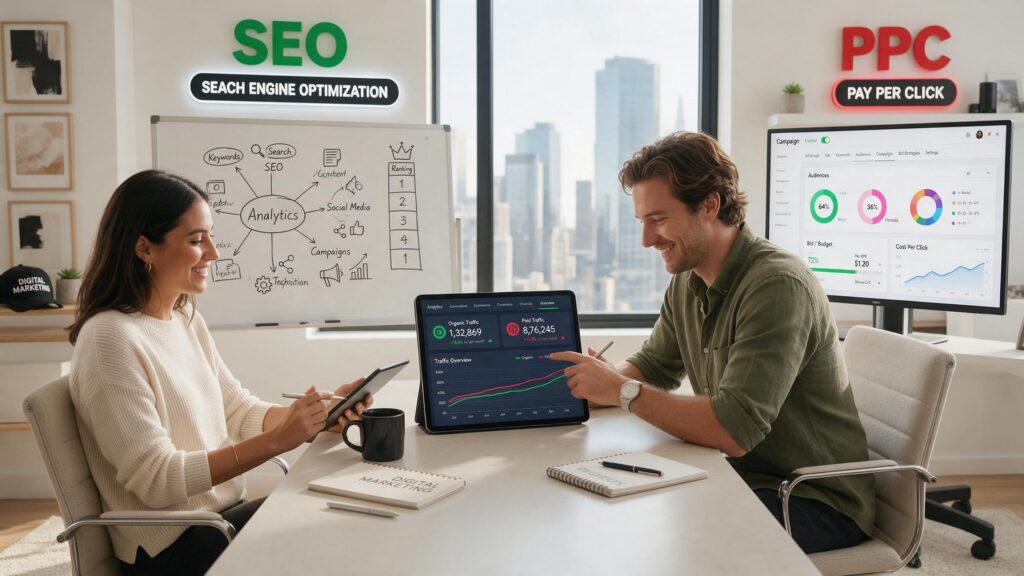
SEO vs PPC, which is the better investment?
This question has been hotly debated in the digital marketing world for well over a decade, and heading into 2026 it’s only gotten more consequential. Search Engine Optimization (SEO) and Pay Per Click (PPC) take two very different approaches to improving a company’s online marketing presence, and the stakes of getting that choice right have grown alongside the cost of getting it wrong. Google Ads costs have climbed steadily, AI generated answers now sit above the traditional “blue links” on nearly half of all searches, and buyers increasingly research products through AI Overviews, ChatGPT, Perplexity, and Gemini before a human ever sees an ad. The fundamentals of the SEO vs PPC debate haven’t changed, but the numbers behind it have shifted enough that any decision based on pre pandemic assumptions is now working from stale data.
When deciding between SEO and PPC, the choice still comes down to your company’s specific goals, timeline, and budget. In this article, Denver Digital explores the benefits and drawbacks of each advertising type. The article includes updated research, tools, and market conditions shaping 2025 and 2026.
Organic Results
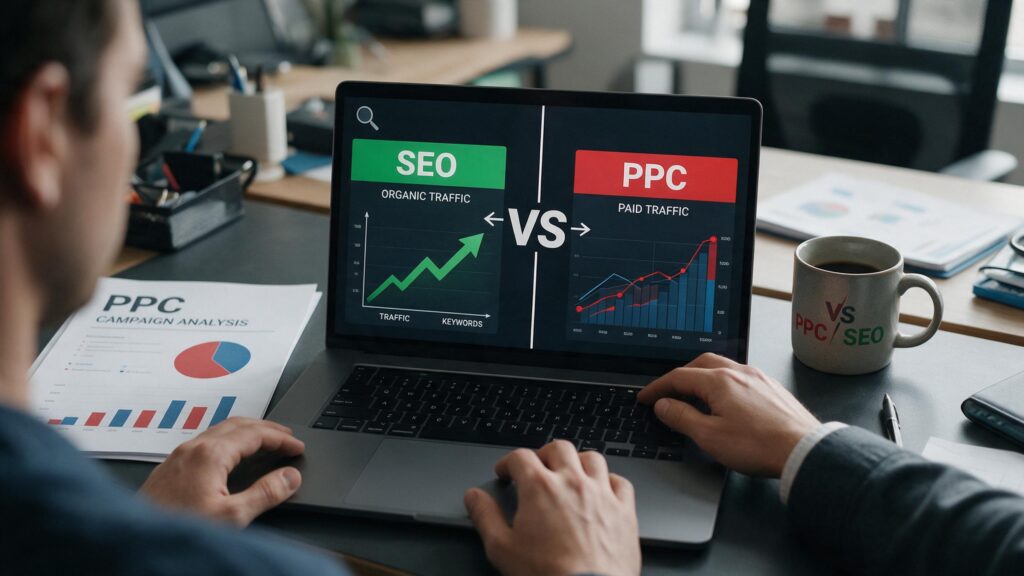
When it comes to producing strong, quality, lasting results, SEO still comes out on top and the data increasingly backs that up. A good SEO team will help you produce website content that naturally ranks higher in organic search results by using the most up to date, on page SEO strategies. That no longer means keyword density and meta tags alone; in 2026 it means structuring content around search intent, entity relationships, and topical depth so it satisfies both traditional ranking algorithms and the large language models now summarizing search results.
Recent industry benchmarks show strong SEO returns for businesses investing in organic search. SEOmator and First Page Sage report SEO ROI figures ranging from roughly 500% to 748%. PPC typically delivers lower long term ROI, averaging around 200% in many analyses. Some studies report PPC returns as low as 36% after accounting for advertising costs. Organic search also continues to dominate overall website traffic. BrightEdge reports that organic search generated roughly 53% of website traffic in 2025. This exceeded every other channel, including paid search and social media combined.
Strong SEO content still encourages users to spend more time on your website. It can also encourage repeat visits and help attract valuable backlinks. However, the standard for quality content has increased significantly. Google’s EEAT principles now influence which pages appear in AI generated answers. EEAT stands for Experience, Expertise, Authoritativeness, and Trustworthiness. AI Overviews are also becoming increasingly important for businesses competing in search. BrightEdge reports that AI Overviews appeared on roughly 48% of tracked Google queries. That figure increased from about 31% during the previous year.
Building links from high quality websites can still improve rankings and online visibility. However, link building has evolved significantly over the past decade. Digital PR, original research, and data backed content now earn links more reliably. These strategies often outperform traditional outreach heavy link building tactics. Strong SEO strategies can also improve your rankings naturally. In 2026, they provide another important benefit for businesses. Well structured, well sourced, expert content is more likely to appear in AI generated answers. Seer Interactive’s 2026 research found an important advantage for brands earning AI Overview citations.These brands receive about 120% more clicks per impression than competitors without citations. Strong SEO content now earns visibility across two search experiences instead of just one.
Producing strong, well written content is still important, but it takes considerable time and resources, arguably more than it used to, given the added need for structured data, topical authority, and AI search optimization on top of traditional on page SEO. For quick results, many companies still turn to PPC.
Quick Results
There are many benefits when it comes to SEO, but speed still isn’t one of them. Organically improving your site’s content and search engine visibility takes time, most 2026 benchmarks put the realistic timeline for meaningful SEO traction at 6 to 12 months, depending on competition and content quality. For quicker results, pay per click advertising (PPC) remains the go to option.
PPC can generate leads faster than organic search for many companies. However, the cost per lead has increased substantially across many industries. WordStream’s 2026 benchmark analyzed more than 13,000 U.S. campaigns.These campaigns ran between April 2025 and March 2026.The average cost per click was $5.42. Legal services averaged $8.67 per click, while dentists averaged $6.49. Home improvement averaged $5.75 per click, while finance and insurance averaged $5.16. These figures represent a significant increase from the roughly $2.00 CPCs cited previously. Those older figures often come from pre 2020 data. They no longer accurately represent today’s paid search market.
The platforms themselves have also changed. Google’s Performance Max campaigns and AI driven automated bidding now handle much of the targeting and optimization that used to require manual management, which lowers the skill floor for launching a campaign but also means advertisers are competing against algorithmically optimized bids across a wider pool of competitors, one reason 87% of industries saw their average CPC rise in 2025, according to recent industry tracking.
Cost per lead has followed suit: HubSpot’s 2025 data shows organic channels producing leads at roughly $31 each, compared to roughly $181 per lead through PPC, meaning SEO can now generate leads at close to 5.8 times lower cost, even though PPC still wins decisively on speed. PPC remains a genuinely strong option for new websites, product launches, and companies that need visibility before organic authority has had time to build, particularly since a brand new domain often has little to no organic ranking power in its first several months regardless of content quality.
Long Term Necessity
PPC will certainly help you jumpstart your online lead generation, but it still isn’t a forever solution, if anything, that’s truer in 2026 than it was in 2018. The moment ad spend stops, visibility disappears with it; unlike a well ranked organic page, paid advertising leaves no lasting value behind. SEO, by contrast, remains a long term necessity, and research now documents the compounding benefits of that investment more clearly than ever.
At the end of the day, SEO helps move your website toward the top of search results. It also helps your business appear in AI generated answers above traditional search results. The goal is to increase visibility while generating more online leads. SEO remains a vital part of modern digital marketing. Today, front page visibility includes citations within AI generated search experiences.These include Google AI Overviews, ChatGPT Search, Perplexity, and Gemini. This emerging discipline is increasingly known as Generative Engine Optimization, or GEO.
This shift does come with real friction, though, and it’s worth naming honestly rather than glossing over. AI Overviews can significantly reduce organic click through rates on traditional search results. Multiple 2025-2026 studies from Ahrefs and Seer Interactive report declines of roughly 58-61%. Some industries experience AI Overviews on 80% or more of their search queries. These industries include healthcare, education, and B2B technology.
This creates a challenge for informational content. Some publishers report organic traffic declines of 30-70% over the past two years. However, this pressure has not eliminated the value of SEO. Instead, it has changed how brands approach organic search. Brands earning AI generated citations often see higher click through rates. Organic traffic also delivers stronger conversion rates than paid traffic. First Page Sage’s 2025 data reports an average SEO conversion rate of 14.6%. PPC conversion rates average roughly 3.75% by comparison. SEO is no longer just about ranking; it’s about being the source an AI system trusts enough to quote.
Frequently Asked Questions
Is SEO still worth it in 2026 with AI Overviews taking over search results? Yes. While AI Overviews have reduced click-through rates on many informational queries, brands cited inside those AI answers see significantly higher engagement than uncited competitors, and SEO driven organic traffic still converts at roughly 4x the rate of PPC traffic.
How much does PPC cost per click in 2026? The average cost-per-click across U.S. campaigns is around $5.42, according to WordStream’s 2026 benchmarks, though this varies by industry, legal services and other high-competition sectors run notably higher.
How long does SEO take to show results? Most businesses start seeing meaningful traction within 6 to 12 months, depending on competition, content quality, and existing domain authority. E commerce sites often see more gradual early gains that accelerate significantly after the first year.
Which has better ROI, SEO or PPC? SEO generally wins on long term ROI, with published figures ranging from roughly 500% to 748% compared to PPC’s average of around 200%. PPC’s advantage is speed, not long term return.
Can a small business use both SEO and PPC at once? Yes, and most successful 2026 strategies do, commonly allocating a majority of budget to SEO for compounding organic growth while reserving a smaller, ongoing share for PPC to maintain immediate visibility, especially for new sites or time sensitive promotions.
What is Generative Engine Optimization (GEO) and how does it relate to SEO? GEO is the practice of optimizing content so it’s more likely to be cited inside AI generated answers from tools like Google AI Overviews, ChatGPT Search, and Perplexity. It builds directly on strong SEO fundamentals, clear structure, credible sourcing, and topical authority, rather than replacing them.
Does PPC traffic convert as well as organic traffic? Generally no. First Page Sage’s 2025 data shows SEO driven traffic converting at around 14.6% on average, compared to roughly 3.75% for PPC, largely because organic searchers tend to be further along in their decision making process.
Conclusion
In conclusion, PPC and SEO remain important for your online business. The reasons have not fundamentally changed since Denver Digital first covered this topic. However, the numbers, platforms, and competitive landscape have evolved. PPC still delivers faster results and can quickly expand your audience. In 2026, that speed comes with measurable costs. Average cost per click is now around $5.42. Cost per lead can also be several times higher than organic channels.
Once a PPC campaign ends, you still lose that visibility immediately, there’s no lingering asset left behind. SEO, meanwhile, remains a necessary building block of any long term, successful campaign, and the case for it has arguably strengthened: it continues to deliver stronger ROI, dramatically lower cost per lead, and meaningfully higher conversion rates than paid search, even as AI Overviews reshape how and how often people click through from search results at all.
The businesses winning in 2026 aren’t choosing one channel and abandoning the other, they’re treating PPC as the fast start engine that generates leads while SEO’s slower, compounding authority builds in the background, and increasingly, they’re extending SEO fundamentals into GEO to earn visibility inside AI generated answers as well as traditional rankings. If you’re weighing where to invest your next marketing dollar, the honest answer is rarely “just SEO” or “just PPC”, it’s understanding which stage of growth your business is in and building a strategy, ideally with an experienced team like Denver Digital, that puts each channel to work where it’s strongest.
This page was updated 10.09.2026