
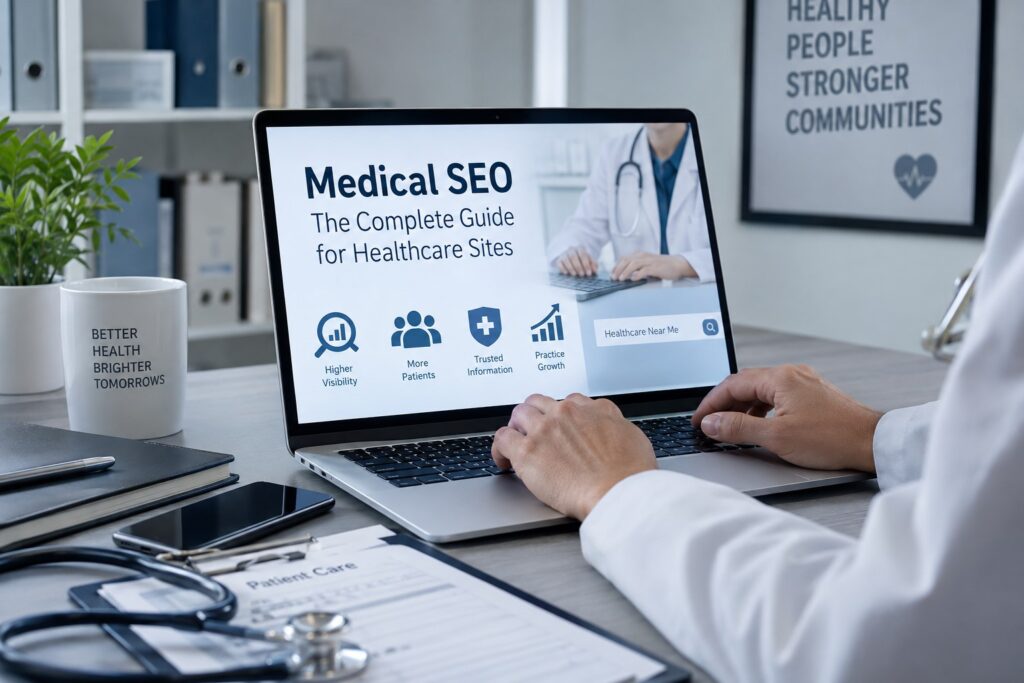
People routinely turn to search engines to understand symptoms, compare treatments, and find a clinician nearby. For a healthcare organization, that makes organic search one of the most important ways new patients first encounter you.
But visibility alone is not the goal. Health content can influence real decisions, so it must be accurate, current, and appropriate for the reader. A page that ranks but misleads, overpromises, or collects sensitive data carelessly creates risk for patients and for the organization.
This guide covers the full medical SEO workflow: what it is, why healthcare differs from other industries, how E-E-A-T and YMYL apply, keyword research, site architecture, on page and technical work, content quality, local SEO, structured data, link earning, conversion, measurement, privacy, common mistakes. Throughout, we separate what Google documents from what practitioners recommend and from hypotheses that lack official support.
What Is Medical SEO?
Medical SEO is the practice of improving a healthcare website so that the people who need it can find it through organic (unpaid) search, and so that what they find is trustworthy and useful. It typically includes:
Website optimization: clear service, specialty, and provider pages that match how patients search.
Organic discovery of providers and services: appearing for searches such as a specialty plus a location.
Medical information content: condition, symptom, and treatment explainers.
Local search visibility: Google Business Profile and map results for in person care.
Technical performance and accessibility: crawlable, fast, mobile friendly, usable pages.
Patient acquisition and trust: helping the right patients take the right next step.
SEO does not guarantee rankings, traffic, appointment volume, or patient outcomes. Search results depend on competition, the quality of your site, and factors outside your control. Treat anyone who promises otherwise with caution.
Why Is SEO Different for Healthcare Websites?
Sensitive information. Health content affects wellbeing, so errors carry higher stakes than in most industries.
Accuracy and responsible communication. Statements should be supported by reputable sources and reviewed by qualified clinicians.
YMYL. Google treats health as a “Your Money or Your Life” area, where it expects higher quality standards (see next section).
Patient trust and decision making. Choosing a clinician is a personal, high consideration decision. Credentials, clarity, reviews, and transparency matter.
Privacy and compliance. Health data is regulated (for example HIPAA in the US, GDPR in the EU/UK), and advertising platforms restrict health targeting.
Traffic versus appropriate patients. A page about a symptom may attract thousands of visitors who are not candidates for your services. Qualified inquiries matter more than raw sessions.
Unsupported claims, exaggerated treatment promises, “guaranteed results,” and implied medical authority that doesn’t exist can mislead patients, violate advertising and professional rules, and erode trust, which in turn undermines the very visibility SEO is meant to build.
Understanding E-E-A-T and YMYL
E-E-A-T stands for Experience, Expertise, Authoritativeness, and Trustworthiness. It comes from Google’s Search Quality Rater Guidelines, which human raters use to evaluate how well search systems perform. Google’s guidance on creating helpful, reliable, people-first content uses E-E-A-T as a lens, and states that trust is the most important element.
Important nuance: E-E-A-T is not a single score and not a simple, direct ranking factor. It is a framework describing qualities Google’s systems aim to reward through many signals. Anyone selling an “E-E-A-T score” is describing a proprietary construct, not an official metric.
In practice for healthcare:
Experience: first hand clinical experience (for example, a surgeon explaining what recovery typically involves in their practice).
Expertise: clear author credentials and, for substantive medical content, review by a qualified clinician.
Authoritativeness: recognition from peers, professional bodies, and reputable organizations.
Trustworthiness: accurate content, cited sources, transparent ownership, real contact details, clear editorial and privacy policies.
Demonstrate these qualities with accurate, verifiable author bios (license, specialty, affiliations), visible “medically reviewed by” statements that are true, published and last reviewed dates, and citations to primary or authoritative sources. Never invent credentials.
YMYL describes topics where low quality information could significantly affect health, financial stability, or safety. Medical advice is a core example, which is why editorial controls on healthcare sites should be stricter than on a typical blog.
Healthcare Website Architecture

Organize around patient needs, not internal departments.
Main service and specialty pages: the backbone; one clear page per distinct service.
Provider biographies: individual pages with credentials, focus areas, languages, and booking links.
Location pages: one per physical location (see local SEO).
Patient resources: insurance, forms, preparing for visits, billing.
Medical blog/education hub: supports informational queries and links to relevant services.
Appointment and contact pages: easy to reach from every page.
Condition pages: when useful. Create a separate condition page when it reflects a distinct patient need and you can provide substantive, original, clinically reviewed content, and when you actually treat the condition. Avoid dozens of near-identical pages that differ only by condition name; they create thin, duplicated content.
Navigation and internal linking. Use meaningful links in navigation, body copy, and related content modules so users and crawlers can reach priority pages. Do not rely on an XML sitemap alone; Google recommends that pages be discoverable through links, and a sitemap is a supplementary hint, not a substitute.
On Page SEO for Medical Websites
Title tags: concise, specific, matching the page topic (for example, “Knee Replacement Surgery in [City] | [BRAND]”). Google may rewrite titles.
Meta descriptions: accurate summaries that earn clicks; not a direct ranking factor, and Google may substitute its own snippet.
H1 and subheadings: one clear H1; subheadings that mirror patient questions.
Search intent alignment: a symptom query deserves an explanation, not a sales pitch.
Descriptive URLs: short, readable, stable (e.g., /services/knee replacement/).
Images and alt text: describe images for accessibility and context; compress for speed. Use real photos of your team and facilities where possible.
Internal links: link related services, providers, and articles with descriptive anchor text.
Calls to action: one primary next step per page (call, book, learn more).
Accurate service descriptions: state only what you provide, to whom, and where.
Updated medical information: review dates and a process to revise outdated content.
Write naturally. Repeating a keyword unnaturally does not help and harms readability. Never mention a procedure, specialty, or outcome that your practice does not actually offer or cannot support.
Creating High Quality Medical Content
Content types worth considering: patient education, service page content, condition explainers, treatment comparisons, FAQs, preventive care guidance, provider authored articles, and clinically reviewed content.
Roles in a sound workflow
Medical writer: researches and drafts in plain language.
Subject matter expert: supplies clinical insight and real-world experience.
Clinical reviewer: a qualified clinician who verifies accuracy and appropriateness before publication.
Editor: checks clarity, sourcing, consistency, and compliance.
Good practice
Cite authoritative sources (clinical guidelines, health agencies, peer reviewed research) and link to them.
Show a publication date and a last reviewed date; make them true.
Provide author and reviewer bios with verifiable credentials.
Publish a short editorial policy describing how content is created, reviewed, and updated.
Include guidance on when to seek care and, where relevant, emergency instructions.
AI generated content. AI tools can assist with outlining or drafting, but unverified AI output can contain confident errors. Google’s position is that it rewards helpful content regardless of how it is produced, while treating content created mainly to manipulate rankings as spam. For medical topics, never publish AI assisted text without fact checking against primary sources and clinical review.
Technical SEO for Healthcare Websites
Prioritize by impact: first make sure important pages can be crawled, indexed, and used; then improve performance; then clean up lower risk warnings.
Crawlability and indexability: confirm priority pages return 200 status, are not blocked by robots.txt, and are not accidentally set to noindex. Use Search Console’s page indexing report.
Robots directives: robots.txt controls crawling, not indexing; use noindex (on crawlable pages) to keep pages out of search. Never rely on robots.txt to protect private data.
XML sitemaps: list canonical, indexable URLs; keep them updated.
Canonical tags: consolidate duplicates (parameters, print versions, near-identical pages).
Redirects: use 301s for permanent moves and avoid long chains.
HTTPS: required in practice for any site handling patient inquiries.
Mobile usability: patients often search on phones; test layouts, tap targets, and click to call.
Core Web Vitals: Largest Contentful Paint (LCP), Interaction to Next Paint (INP), and Cumulative Layout Shift (CLS) measure loading, responsiveness, and visual stability. They are one of many signals; great content is not replaced by fast pages. See Google’s Core Web Vitals documentation.
Image performance: modern formats, correct dimensions, lazy loading below the fold.
JavaScript rendering: ensure key content and links are present in rendered HTML that Google can process.
Duplicate pages and broken links: consolidate and fix those affecting important pages first.
Accessibility: semantic headings, alt text, sufficient contrast, keyboard navigation, labeled forms. Accessibility benefits patients and may be a legal requirement in your jurisdiction.
Secure handling of sensitive information: forms collecting health details must use encrypted transport and compliant systems; avoid sending protected information by plain email.
Prioritizing: audit tools produce long lists. Triage by does it prevent important pages from being found or used, how many key pages does it affect, how hard is the fix. A missing alt attribute on a decorative image is not equal to an accidental noindex on your top service page.
Local SEO for Clinics and Medical Practices
Many healthcare searches have local intent. Appearing in map results and local listings can drive calls and directions requests.
Google Business Profile (GBP): claim and verify each location; follow Google’s guidelines on eligibility and representation.
Accurate information: name, address, phone, hours, website, and appointment link must match your site and other listings. Keep holiday and temporary closures updated.
Categories: choose the most accurate primary category and relevant secondary ones.
Provider and location pages: link GBP to the matching location page, not just the homepage.
Citations: consistent listings on reputable directories, including health specific ones.
Ethical review management: invite honest feedback from real patients, respond professionally, and never reveal protected health information in replies. Do not buy, fake, or selectively gate reviews. Be aware that responding to reviews can inadvertently confirm someone is a patient.
Location specific content: parking, transit, nearby landmarks, local team, services available at that site.
Appointment links: direct, working booking options.
Multiple locations: one unique page per physical location with genuinely distinct information.
Avoiding doorway style pages. Do not create dozens of near identical pages that swap a city name to capture searches in areas where you have no presence. Google’s spam policies treat such doorway pages as a violation. A location page should exist only where you serve patients and should offer unique, useful details.
Structured Data for Medical Websites
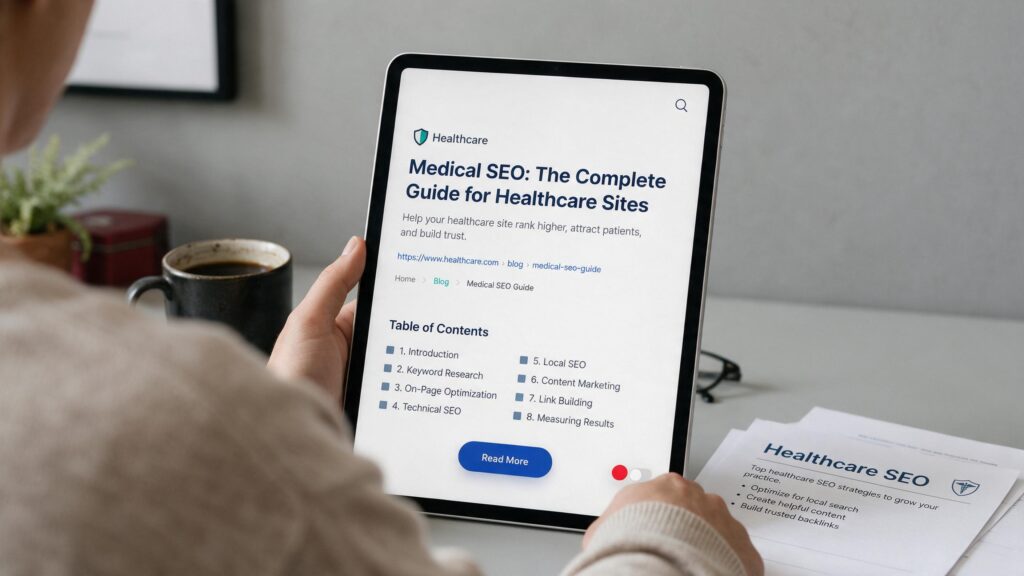
Structured data is code that describes what a page is about in machine readable form. Its purpose is to help search engines understand content and, for certain supported types, make pages eligible for enhanced search features.
Types commonly relevant to healthcare (choose based on what the entity actually is):
Organization / MedicalOrganization: the legal or operating entity.
MedicalClinic: a physical clinic location.
Physician: an individual doctor, where a dedicated profile page exists.
LocalBusiness: for locations (many medical subtypes inherit from it).
Article: editorial content, with author and dates.
BreadcrumbList: site hierarchy.
WebSite: site level information.
Limits to understand
Structured data does not directly improve rankings and does not guarantee enhanced results. Google lists the types it supports for rich results in its structured data gallery; many schema.org medical types are not part of that gallery.
Markup must reflect visible page content. Mismatched or misleading markup can violate Google’s guidelines.
FAQ markup: according to Google’s FAQPage documentation, FAQ rich results stopped appearing in Google Search on May 7, 2026 (previously they were limited to well-known government and health sites). The FAQPage type is still valid schema.org vocabulary and Google says it may still use markup to understand pages, but do not expect an FAQ dropdown in results. Check Google’s current FAQPage documentation before investing effort.
Google’s guidance on AI features states that no special schema.org markup is required to appear in generative AI search results.
Validate markup with Google’s Rich Results Test or the Schema Markup Validator, and keep it accurate when details change.
Link Earning and Healthcare Authority
Links from relevant, reputable sources remain a useful signal of recognition. Earn them rather than buy them.
Original research or data: anonymized practice statistics (with appropriate privacy safeguards) or surveys.
Expert commentary: clinicians contributing to journalists and health publications.
Professional associations: member directories and credential listings.
Community health initiatives: screenings, education events, sponsorships with real community value.
Educational resources: guides, checklists, and tools others genuinely reference.
Legitimate partnerships: hospitals, universities, nonprofits.
Reputable local organizations: chambers of commerce, local news, schools.
Avoid: paid link schemes, manipulative link exchanges, fabricated medical citations, and low quality mass guest posting. These can trigger manual actions under Google’s spam policies and damage reputation.
Patient Conversion and Website Experience
Traffic only matters if people can take an appropriate next step.
Clear appointment options: online booking, phone, and form, easy to find.
Readable provider biographies: photo, specialty, approach, languages, booking link.
Accessible forms: short, labeled, keyboard and screen reader friendly.
Transparent contact information: address, phone, hours on every location page.
Mobile friendly calls to action: tap to call and sticky booking buttons that don’t obstruct content.
Insurance and payment information: accepted plans, self pay options, and how to verify coverage, where relevant.
Clear explanations of services: what to expect, who it is for, and who it is not for.
Emergency guidance: state plainly that urgent or life threatening symptoms require emergency services, not a web form.
Do not invite users to submit sensitive health details through insecure forms or general purpose email. Collect only what you need and use compliant, encrypted systems.
Measuring Medical SEO Performance
Use Google Search Console for search data and a privacy conscious analytics setup for on-site behavior.
Impressions, clicks, and query visibility: which searches show your pages.
Landing page performance: are priority pages gaining relevant visibility?
Qualified appointment inquiries: the metric closest to business value; define “qualified” with your intake team.
Phone and appointment interactions: call tracking and booking events, only where lawful and configured appropriately.
Conversion rates: by page type and device.
Technical health: index coverage, Core Web Vitals, crawl errors.
Local visibility: GBP views, calls, direction requests, local rank checks.
Content quality and maintenance: share of pages reviewed on schedule.
Attribution limits. Patients often research across devices, call without clicking, or book after a referral. Not every appointment can be traced to SEO. Combine analytics with intake questions (“How did you hear about us?”) and look at trends, not single data points.
Privacy and tracking. In the US, HHS’s Office for Civil Rights issued a 2022 bulletin on online tracking technologies; in June 2024 a federal court vacated part of it (the portion concerning IP addresses on unauthenticated public pages), and HHS later dropped its appeal. That ruling did not remove HIPAA obligations: tracking on authenticated pages such as patient portals, or tools that capture identifiable health information, can still raise issues, and FTC and state laws (for example Washington’s My Health My Data Act) apply separately. In the EU/UK, consent rules apply. Have privacy counsel review analytics, advertising pixels, and session recording tools before deployment, and avoid sending health related details to third party platforms. This is general information, not legal advice.
Common Medical SEO Mistakes
Publishing inaccurate or unsupported health claims.
Using unqualified authors for clinical content without clinical review.
Overusing keywords.
Creating thin service pages with little unique information.
Duplicating location pages.
Ignoring technical problems that block important pages.
Using misleading, purchased, or gated reviews.
Treating schema as a ranking shortcut.
Neglecting content maintenance and outdated guidance.
Making unsupported ranking or patient growth promises.
Frequently Asked Questions
1. What is medical SEO? It is the work of making a healthcare website discoverable, useful, and trustworthy in organic search, covering content, technical quality, local presence, and measurement.
2. Why is healthcare SEO different from regular SEO? Because health information is a YMYL topic with higher accuracy expectations, and because privacy, advertising, and professional rules add constraints most industries don’t face.
3. How long does medical SEO take to produce measurable results? There is no universal timeline. It depends on the site’s current state, competition, how much needs fixing, and how quickly changes are implemented and re-crawled. Early technical or local fixes may show movement sooner than content-driven growth, but anyone quoting a fixed number is guessing.
4. Does Google require every medical article to be written by a doctor? No. Google does not set that requirement. It emphasizes demonstrable expertise and trust, so for substantive medical content, authorship or review by a qualified professional is a sound practice, and sourcing and accuracy matter regardless.
5. Is E-E-A-T a direct Google ranking factor? Not in a simple sense. It is a framework from the rater guidelines describing qualities Google’s systems try to reward through many signals; there is no single E-E-A-T score.
6. How often should medical content be reviewed? There is no official interval. A reasonable approach is a defined schedule (for example, at least annually for stable topics and sooner when guidelines, regulations, or services change), with high-risk topics reviewed more often.
7. Does every clinic need a Google Business Profile? Any clinic serving patients at a physical location, or in a defined service area, that wants local visibility should usually have one, provided it meets Google’s eligibility guidelines.
8. Is structured data necessary for healthcare websites? No. It can help search engines understand your pages and may enable certain features, but it is not required and does not guarantee rankings or rich results.
9. How much does medical SEO cost? Costs vary widely by scope, number of locations, competition, and whether work is in-house or outsourced. Request itemized proposals tied to deliverables rather than relying on a generic price.
10. Can AI generated content rank for medical searches? Google says it evaluates content by helpfulness and quality, not by how it was produced. But unverified AI text in a health context risks inaccuracy and low trust; use it only as an assistive tool, followed by fact checking and clinical review.
Conclusion
Effective medical SEO is less about tricks and more about building a site patients can find, understand, and trust: technically sound, clinically accurate, easy to use, and honest about what you offer. Start with the foundations, prioritize by impact, protect patient privacy, and measure outcomes that matter.